(To see other currencies, click on price)
MORE ABOUT THIS BOOK
Main description:
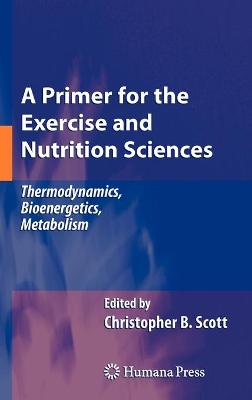
What a journey writing this text has been. The lengthy voyage started well before the idea hatched of authoring a text that contained the word "thermodynamics"! I was informed by my good friend and sometimes colleague Dr. Jose Antonio that by including that word in the title, nutritionists and exercise physiologists might avoid the subject. But almost every step of my expedition was taken on a rather solid foundation of thermodynamics and as such the topic could not possibly be omitted from the title or the text of a book about bioenergetics and energy expenditure. I am not a physicist. In fact I ?rst went to college to become a football coach. That vocational choice began to deteriorate when taking the mandatory anatomy and physiology courses required of all physical education majors. This information was exciting; my interest in physical education began to wane. During sophomore year, I answered an advertisement in the school newspaper requesting research subjects.
Contents:
Preface 1. Introduction: Thermodynamics, Bioenergetics, Energy Expenditure Part 1. Thermodynamics 2. Within and Without: Systems and Surroundings 2.1. Isolated systems 2.2. Closed systems 2.3. Open systems 2.4. Life is an open system 3. Conservation 4. Matter and Energy 4.1. Matter 4.2. Energy 4.3. Internal energy 4.4. Internal energy exchanges 5. Energy Accountability: Enthalpy (H) 5.1. The chemical reaction system 5.2. Chemical (standard) enthalpy exchanges 5.3. Biochemical (non-standard) enthalpy exchange 6. Energy has bias: Entropy (S) 6.1. 2nd laws of thermodynamics 6.2. Energy distribution 7. The energy exchange gradient: Gibbs energy (G) 7.1. Delta Go 7.2. Energy unification 7.3. Delta Go': Closed systems under standard conditions 7.4. Delta G: Non-standard conditions Part 2. Bioenergetics 8. Life's Currency: ATP 8.1. ATP: structure and content 8.2. ATP: energy exchange 8.3. ATP: turnover efficiency 8.4. ATP utilization (demand) 8.5. ATP re-synthesis 9. Metabolism as an Energy Exchange Device 9.1. Metabolic power: force and flow 9.2. Negative entropy (?) 9.3. Dynamics of a metabolic pathway 9.4. Intracellular transport 9.5. Time 9.6. Exergy synopsis 10. Anaerobic Metabolism 10.1. A brief history of anaerobic biochemistry 10.2. The glycolytic gradient 10.3. Glycolytic heat and entropy 10.4. 'High-energy' phosphate buffering 10.5. Anaerobic speed 11. Aerobic Metabolism 11.1. Mitochondria 11.2. Krebs cycle: gradient 1 11.3. Electron transport chain: gradient 2 11.4. Proton-motive force: gradient 3 11.5. The creatine phosphate shuttle 11.6. ATP tally Part 3. Energy Expenditure 12. Aerobic Energy Expenditure 12.1. Combustion, respiration and heat 12.2. Thornton's law: combustion 12.3. Respiration and energy expenditure 12.4. Heat and gas exchange 12.5. Aerobic energy expenditure as heat and entropy 12.6. CO2 and O2: aerobic and anaerobic energy exchange 13. Anaerobic Energy Expenditure 13.1. The oxygen deficit 13.2. Lactate 14. Energy Expenditure at Rest 14.1. Measuring energy expenditure: calorimetry 14.2. The energy expenditure of rest 14.3. Eating and energy expenditure 14.4. Pregnancy and energy expenditure 15. Energy Expenditure of Activity (Work and Exercise) 15.1. Rate vs capacity vs METs 15.2. Muscle 15.3. Work and energy expenditure relationships 15.4. Glycolytic versus respiratory efficiency 16. Total Energy Expenditure for Exercise and Recovery 16.1. Aerobic exercise energy expenditure 16.2. Anaerobic exercise energy expenditure 16.3. Aerobic recovery energy expenditure 16.4. Dismissing the oxygen debt hypothesis 16.5. Total energy expenditure 16.6. Weight loss: low vs high intensity activity
PRODUCT DETAILS
Publisher: Springer (Humana Press Inc.)
Publication date: December, 2010
Pages: 182
Weight: 454g
Availability: Available
Subcategories: Biochemistry, Physiology, Public Health, Sports Medicine
Publisher recommends