
(To see other currencies, click on price)
MORE ABOUT THIS BOOK
Main description:
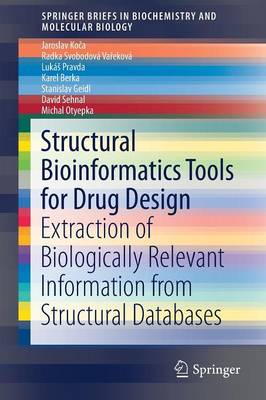
The book describes the individual steps necessary for biomacromolecular fragments analysis, as well as a list of essential software tools. For each step, it also shows corresponding web-based tools in detail and provides practical examples of their use.
All tools and databases mentioned in the examples are available free of charge, platform-independent, web-based, user-friendly and do not require a prior IT background to be fully used.
Contents:
1. Introduction
Description of current situation about biomacromolecular structural data, their amount, growth, availability. Motivation, why it has sense to process and analyze these data, including applications towards drug design. Description of basic steps of their analysis via structural bioinformatics approaches.
2. Biomacromolecular fragments
3. Databases
Status of current structural databases focused on biomacromolecules, ligands, fragments, structural patterns etc. Practical examples based on PDBe and PDBsum.
4. Detection & Extraction
Languages and formalisms for description, detection, extraction and comparison of biomacromolecular fragments and structural patterns. Practical examples based on PatternQuery and SiteBinder.
Approaches and software tools for extraction of channels and pores. Practical examples based on MOLE.
5. Validation
Methodologies and software tools for validation of biomacromolecules and ligands. Practical examples based on MotiveValidator, ValidatorDB and PDBe validation reports.
6. Characterization
Calculation of partial atomic charges of biomacromolecules and ligands. Practical examples based on AtomicChargeCalculator.
Calculation of channel characteristics (radius, length, lining residues, physico-chemical properties). Practical examples based on MOLE.
7. Selected Examples
Few biologically relevant examples where all or most of the tools would be used. Small exemplary bioinformatics project. Problem formulation -> fragment(s) definition -> database search and data extraction -> data validation -> atomic charges calculation/biomacromolecular channel ^ conclusions.
PRODUCT DETAILS
Publisher: Springer (Springer International Publishing AG)
Publication date: February, 2017
Pages: 155
Weight: 2526g
Availability: Available
Subcategories: Biomedical Engineering, Pharmacology