
(To see other currencies, click on price)
MORE ABOUT THIS BOOK
Main description:
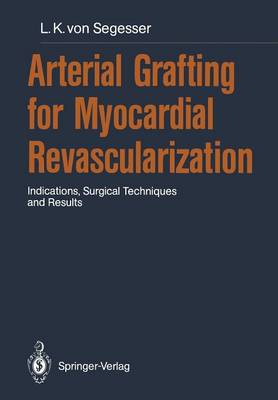
Cardiovascular disease, the leading cause of With increased experience using the inter- death in industrialized societies, not only nal mammary artery, these groups of sur- strikes down a significant fraction of the geons eventually applied the procedure to a population without warning, but also causes larger population of patients. Eventually, prolonged suffering and disability in even the mammary artery was used in sequential larger number. Until the development of fashion to bypass more than one artery, and, heart surgery and the introduction of diag- in some patients, both mammary arteries nostic techniques including cineangiogra- were used. Using these new techniques, sur- phy, stress electrocardiography, echocardio- geons could bypass almost every area of the graphy, and myocardial scanning, the diseased coronary system except the distal treatment of arteriosclerotic heart disease circumflex branches and distal right branch- was confined to medical measures that were es. Then, in 1983 and in 1985, Campeau and usually only partially effective. Lytle published the results of their long-term After the introduction of selective coro- studies of mammary artery bypass.
These nary angiography by Sones, surgeons, led by important reports showed significantly dif- Favaloro and Johnson, began to apply the ferent results in favor of the internal mam- principle of bypass to coronary arterial dis- mary artery over the saphenous vein graft. ease.
Contents:
1 Introduction.- 2 Myocardial Revascularization and the Internal Mammary Artery.- 2.1 History of Myocardial Revascularization.- 2.2 Indications for Surgical Coronary Artery Revascularization Today.- 2.3 Early and Late Results of Coronary Artery Bypass Grafting: Attrition of Saphenous Vein Grafts.- 3 Anatomy of the Internal Mammary Artery.- 3.1 Normal Anatomy.- 3.1.1 Macroscopic Studies.- 3.1.2 Microscopic Studies.- 3.2 Anatomical Variations.- 4 Pathology of the Internal Mammary Artery and the Subclavian Artery.- 4.1 Angiographic Studies.- 4.2 Microscopic Studies.- 5 Experimental Studies.- 5.1 Flow Studies in Animals.- 5.1.1 Normal Internal Mammary Artery Flow.- 5.1.2 Internal Mammary Artery Flow and Vasoactive Drugs.- 5.1.3 Internal Mammary Artery Flow Under Pathological Hemodynamic Conditions.- 5.1.3.1 Material and Methods.- 5.1.3.2 Results.- 5.1.3.3 Discussion.- 5.2 Physiological and Pathophysiological Basis for the Superiority of Internal Mammary Artery Grafts in Comparison to Saphenous Vein Grafts.- 5.2.1 Internal Mammary Arteries and Prostacyclin Production.- 5.2.2 Endothelium-dependent Relaxations of the Internal Mammary Artery.- 5.2.3 Early Postoperative Changes of Saphenous Vein Grafts.- 5.3 Expanded Use of the Internal Mammary Artery.- 5.3.1 Free Internal Mammary Artery Grafts (Canine Experiments).- 5.3.2 Retrograde Internal Mammary Artery - Coronary Artery Anastomoses (Canine Experiments).- 5.3.2.1 Material and Methods.- 5.3.2.2 Results.- 5.3.2.3 Discussion.- 5.4 Alternative Grafts for Coronary Artery Revascularization.- 5.4.1 Autologous Alternative Graft Materials.- 5.4.2 Homologous Alternative Graft Materials.- 5.4.3 Biological Substitutes.- 5.4.4 Synthetic Grafts.- 5.4.5 Grafts of the Future.- 6 Clinical Studies.- 6.1 Flow Studies in Humans.- 6.2 Expanded Use of the Internal Mammary Artery in Clinical Coronary Artery Revascularization.- 6.2.1 Sequential Internal Mammary Artery - Coronary Artery Anastomoses.- 6.2.2 Free (Aortocoronary) Internal Mammary Artery Grafts.- 6.2.3 Bilateral Internal Mammary Artery - Coronary Artery Grafting...- 6.2.4 "Prophylactic" Coronary Artery Bypass Grafts.- 7 Clinical Application of Internal Mammary Artery - Coronary Artery Bypass Grafting.- 7.1 Indications for Internal Mammary Artery - Coronary Artery Bypass Grafting.- 7.2 Contraindications for Internal Mammary Artery - Coronary Artery Bypass Grafting.- 7.2.1 Limited Flow in the Early Postoperative Period.- 7.2.2 Increased Intrathoracic Injury.- 7.2.3 More Difficult and Time-Consuming Procedure.- 7.3 Surgical Techniques of Clinical Internal Mammary Artery - Coronary Artery Bypass Grafting.- 7.3.1 Take-Down of the Internal Mammary Arteries.- 7.3.2 Evaluation of the Internal Mammary Artery.- 7.3.3 Cannulation, Cardiopulmonary Bypass and Cardioplegia.- 7.3.4 Internal Mammary Artery - Coronary Artery Anastomoses.- 7.3.4.1 End-to-Side Anastomosis Between the Internal Mammary Artery and the Coronary Arteries.- 7.3.4.2 Sequential Internal Mammary Artery - Coronary Artery Grafting and Side-to-Side Anastomoses.- 7.3.4.3 Internal Mammary Artery - Coronary Artery Y-Anastomoses.- 7.3.4.4 Bilateral Internal Mammary Artery - Coronary Artery Anastomoses.- 7.3.4.5 Maximization of Internal Mammary Artery Length.- 7.3.4.6 Free (Aortocoronary) Internal Mammary Artery Graft Anastomoses.- 7.3.5 Weaning from Cardiopulmonary Bypass.- 7.3.6 Hemostasis.- 7.3.6.1 Autotransfusion.- 7.3.6.2 Preservation and/or Reactivation of Platelets and Coagulation Factors.- 7.3.6.3 Improved Cardiopulmonary Bypass Equipment.- 7.3.7 Drainage.- 7.3.8 Closure of the Pericardial Sac and the Chest.- 8 Results of Internal Mammary Artery - Coronary Artery Bypass Grafting.- 8.1 Early Results.- 8.1.1 Actual Series of Internal Mammary Artery - Coronary Artery Grafting.- 8.1.1.1 Material and Methods.- 8.1.1.2 Results.- 8.1.1.2.1 Preoperative Variables.- 8.1.1.2.2 Operative Variables.- 8.1.1.2.3 Postoperative Variables.- 8.1.1.2.3.1 Mortality.- 8.1.1.2.3.2 Morbidity.- 8.1.1.2.3.3 Follow-up.- 8.1.2 Early Results of Expanded Internal Mammary Artery Grafting in Comparison to Classic Saphenous Vein Grafting.- 8.1.3 Evolution of Perioperative Mortality in Coronary Artery Revascularization.- 8.2 Medium-Term Results of Internal Mammary Artery - Coronary Artery Grafting.- 8.2.1 Patients and Methods.- 8.2.2 Results.- 8.2.3 Comments.- 8.3 Late Results of Internal Mammary Artery - Coronary Artery Grafting.- 9 Complications of Internal Mammary Artery Grafting.- 9.1 Inadequate Flow After Internal Mammary Artery - Coronary Artery Revascularization.- 9.1.1 Patients and Methods.- 9.1.2 Results.- 9.1.3 Comments.- 9.2 Spasms After Coronary Artery Revascularization.- 9.2.1 Coronary Artery Spasm Immediately After Saphenous Vein Grafting.- 9.2.2 Spasm After Internal Mammary Artery Grafting.- 9.3 Mechanical Circulatory Support After Internal Mammary Coronary Artery Grafting.- 9.4 Sternal Infections Following Internal Mammary Artery - Coronary Artery Grafting.- 9.5 Other Complications After Internal Mammary Artery Grafting.- 10 Long Term Follow-up After Internal Mammary Artery - Coronary Artery Revascularization.- 10.1 Freedom From Reinfarction After Coronary Artery Revascularization.- 10.2 Objective Assessment of the Results of Internal Mammary Artery - Coronary Artery Revascularization.- 10.2.1 Scintigraphic Evaluation.- 10.2.2 Angiographic Evaluation.- 10.3 Late Patency Rates of Internal Mammary Artery Grafts.- 11 Redo Coronary Artery Revascularization After Internal Mammary Artery Grafting.- 11.1 Percutaneous Transluminal Angioplasty After Internal Mammary Artery Grafting.- 11.2 Reoperation After Internal Mammary Artery Grafting.- 11.2.1 Completely Occluded Internal Mammary Artery Graft.- 11.2.2 Patent, but Stenosed Internal Mammary Artery Graft.- 11.2.3 Patent, not Stenosed Internal Mammary Artery Graft.- 12 Conclusion.- References.- Suppliers of Material.
PRODUCT DETAILS
Publisher: Springer (Springer-Verlag Berlin and Heidelberg GmbH & Co. K)
Publication date: December, 2011
Pages: 157
Weight: 293g
Availability: Available
Subcategories: Cardiothoracic, Cardiovascular Medicine, Vascular