
(To see other currencies, click on price)
MORE ABOUT THIS BOOK
Main description:
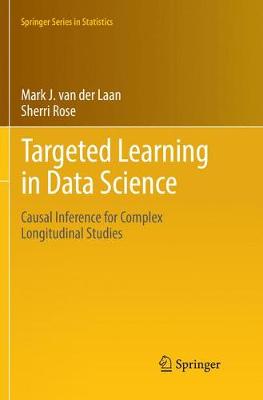
This textbook for graduate students in statistics, data science, and public health deals with the practical challenges that come with big, complex, and dynamic data. It presents a scientific roadmap to translate real-world data science applications into formal statistical estimation problems by using the general template of targeted maximum likelihood estimators. These targeted machine learning algorithms estimate quantities of interest while still providing valid inference. Targeted learning methods within data science area critical component for solving scientific problems in the modern age. The techniques can answer complex questions including optimal rules for assigning treatment based on longitudinal data with time-dependent confounding, as well as other estimands in dependent data structures, such as networks. Included in Targeted Learning in Data Science are demonstrations with soft ware packages and real data sets that present a case that targeted learning is crucial for the next generation of statisticians and data scientists. Th is book is a sequel to the first textbook on machine learning for causal inference, Targeted Learning, published in 2011.
Mark van der Laan, PhD, is Jiann-Ping Hsu/Karl E. Peace Professor of Biostatistics and Statistics at UC Berkeley. His research interests include statistical methods in genomics, survival analysis, censored data, machine learning, semiparametric models, causal inference, and targeted learning. Dr. van der Laan received the 2004 Mortimer Spiegelman Award, the 2005 Van Dantzig Award, the 2005 COPSS Snedecor Award, the 2005 COPSS Presidential Award, and has graduated over 40 PhD students in biostatistics and statistics.
Sherri Rose, PhD, is Associate Professor of Health Care Policy (Biostatistics) at Harvard Medical School. Her work is centered on developing and integrating innovative statistical approaches to advance human health. Dr. Rose's methodological research focuses on nonparametric machine learning for causal inference and prediction. She co-leads the Health Policy Data Science Lab and currently serves as an associate editor for the Journal of the American Statistical Association and Biostatistics.
Contents:
Part I: Introductory Chapters
1. The Statistical Estimation Problem in Complex Longitudinal Data
Data Science and Statistical Estimation
Roadmap for Causal Effect Estimation
Role of Targeted Learning in Data Science
Observed Data
Caussal Model and Causal target Quantity
Statistical Model
Statistical Target Parameter
Statistical Estimation Problem
2. Longitudinal Causal Models
Structural Causal Models
Causal Graphs / DAGs
Nonparametric Structural Equation Models
3. Super Learner for Longitudinal Problems
Ensemble Learning
Sequential Regression
4. Longitudinal Targeted Maximum Likelihood Estimation (LTMLE)
Step-by-Step Demonstration of LTMLE
scalable inference="" for="" big="" data
5. Understanding LTMLE
Statistical Properties
Theoretical Background
6. Why LTMLE?
Landscape of Other Estimators
Comparison of Statistical Properties
Part II: Additional Core Topics
7. One-Step TMLE
General Framework
Theoretical Results
8. One-Step TMLE for the Effect Among the Treated
Demonstration for Effect Among the Treated
Simulation Studies
9. Online Targeted Learning
Batched Streaming Data
Online and One-Step Estimator
Theoretical Considerations
10. Networks
General Statistical Framework
Causal Model for Network Da
ta
Counterfactual Mean Under Stochastic Intervention on the Network
Development of TMLE for Networks
Inference
11. Application to Networks
Differing Network Structures
Realistic Network Examples (e.g., effect of vaccination)
R Package Implementation of TMLE
12. Targeted Estimation of the Nuisance Parameter
Asymptotic Linearity
IPW
TMLE
13. Sensitivity Analyses
General Nonparametric Approach to Sensitivity Analysis
Measurement Error
Unmeasured Confounding
Informative Missingness of the Outcome
FDA Meta-Analysis
Part III: Randomized Trials
14. Community Randomized Trials for Small Samples
Introduction of SEARCH Community Rando
mized Trial
Adaptive Pair Matching
Data-Adaptive Selection of Covariates for Small Samples
TMLE Using Super Learning for Small Samples
Inference
15. Sample Average Treatment Effect in a CRT
Introduction of the Parameter
Effect for the Observed Communities
Inference
16. Application to Clinical Trial Survival Data
Introduction of the Survival Parameter
Censoring
Treatment-Specific Survival Function
17. Application to Pandora Music Data
Effect of Pandora Streaming on Music Sales
Application of TMLE
18. Causal Effect Transported Across Sites
Intent-to-Treat ATE
Complier ATE
Incomplete Data
Moving to Opportunity Trial
Part IV: Observational Longitudinal Data
19. Super Learning in the ICU
ICU Prediction Problem
Super Learning Algorithm
Defining Stochastic Interventions
Dependence on True Treatment Mechanisms
Continuous Exposure
Air Pollution Data Example
21. Stochastic Multiple-Time-Point Interventions on Monitoring and Treatment
Defining Stochastic Interventions for Multiple-Time Points
Introduction of Monitoring Problem
Non-direct Effect Assumption of Monitoring
Dynamic Treatment
Diabetes Data Example
22. Collaborative LTMLE
Collaborative LTMLE Framework
Breastfeeding Data Example
Part V: Optimal Dynamic Regimes
23. Targeted Adaptive Designs Learning the Optimal Dynamic Treatment
Group-Sequential Adaptive Designs
Multiple Bandit Problem
Treatment Allocation Learning from Past Data
Mean Outcome Under the Optimal Treatment
Martingale Theory
Inference
24. Targeted Learning of the Optimal Dynamic Treatment
Super Learning for Discovering the Optimal Dynamic rule
Different Loss Functions
TMLE for the Counterfactual Mean
Statistical Inference for the Mean Outcome Under the Optimal Rule
25. Optimal Dynamic Treatments Under Resource Constraints
Constrained Optimal Dynamic Treatment
Super Learning of the Constrained Optimal Dynamic Regime
TMLE of the Counterfactual Mean Under the Constrained
Optimal Dynamic Regime
Part VI: Computing
26. ltmle() for R
Introduction to the ltmle() R Package
Demonstration of the ltmle() R Package
27. Scaled Super Learner for R
Introduction to the H2O Environment
R Package
Subsemble
28. Scaling CTMLE for Julia
Scaling Computing of CTMLE in Julia
Pharmacoepidemiology Example
Part VII: Special Topics
29. Data-Adaptive Target Parameters
Definition of Parameter
Examples of Data-Adaptive Target Parameters as Arise in Data Mining
Estimators of the Data-Adaptive Target Parameters Using Sample Splitting
Estimators of the Data-Adaptive Target Parameters Without Sample Splitting
Cross-Validated TMLE of the Data-Adap
tive Target Parameters
30. Double Robust Inference for LTMLE
The Challenge of Double Robust Inference for Double Robust Estimators
31. Higher-Order TMLE
Higher-Order Pathwise Differentiable Target Parameters
Higher-Order TMLE
Kth Order Remainder
Parameters Not Second-Order Pathwise Differentiable
Second-Order U Statistics
Approximate Second-Order Influence Function
Approximate Second-Order TMLE
Appendices
A. Online Targeted Learning Theory
B. Computerization of the Calculation of Efficient Influence Curve
C. TMLE Applied to Capture/Recapture
D. TMLE for High Dimensional Linear Regression
E. TMLE of Causal Effect Based on Observing a Single Time Series
PRODUCT DETAILS
Publisher: Springer (Springer Nature Switzerland AG)
Publication date: December, 2018
Pages: 640
Weight: 1032g
Availability: Available
Subcategories: Biomedical Engineering, Public Health