(To see other currencies, click on price)
MORE ABOUT THIS BOOK
Main description:
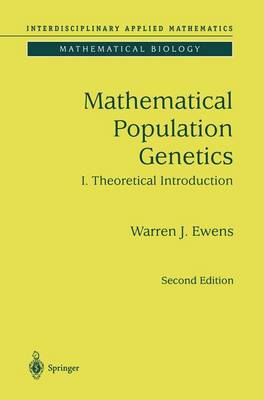
This is the first of a planned two-volume work discussing the mathematical aspects of population genetics with an emphasis on evolutionary theory. This volume draws heavily from the author's 1979 classic, but it has been revised and expanded to include recent topics which follow naturally from the treatment in the earlier edition, such as the theory of molecular population genetics.
Contents:
Contents
Preface
Introduction
1 Historical Background
1.1 Biometricians, Saltationists and Mendelians
1.2 The Hardy-Weinberg Law
1.3 The Correlation Between Relatives
1.4 Evolution
1.4.1 The Deterministic Theory
1.4.2 Non-Random-Mating Populations
1.4.3 The Stochastic Theory
1.5 Evolved Genetic Phenomena
1.6 Modelling
1.7 Overall Evolutionary Theories 2 Technicalities and Generalizations
2.1 Introduction
2.2 Random Union of Gametes
2.3 Dioecious Populations
2.4 Multiple Alleles
2.5 Frequency-Dependent Selection
2.6 Fertility Selection
2.7 Continuous-Time Models
2.8 Non-Random-Mating Populations
2.9 The Fundamental Theorem of Natural Selection
2.10 Two Loci
2.11 Genetic Loads
2.12 Finite Markov Chains 3 Discrete Stochastic Models
3.1 Introduction
3.2 Wright-Fisher Model: Two Alleles
3.3 The Cannings (Exchangeable) Model: Two Alleles
3.4 Moran Models: Two Alleles
3.5 K-Allele Wright-Fisher Models
3.6 Infinitely Many Alleles Models
3.6.1 Introduction
3.6.2 The Wright-Fisher In.nitely Many Alleles Model
3.6.3 The Cannings In.nitely Many Alleles Model
3.6.4 The Moran In.nitely Many Alleles Model
3.7 The Effective Population Size
3.8 Frequency-Dependent Selection
3.9 Two Loci 4 Diffusion Theory
4.1 Introduction
4.2 The Forward and Backward Kolmogorov Equations
4.3 Fixation Probabilities
4.4 Absorption Time Properties
4.5 The Stationary Distribution
4.6 Conditional Processes
4.7 Diffusion Theory
4.8 Multi-dimensional Processes
4.9 Time Reversibility
4.10 Expectations of Functions of Di.usion Variables 5 Applications of Diffusion Theory
5.1 Introduction
5.2 No Selection or Mutation
5.3 Selection
5.4 Selection: Absorption Time Properties
5.5 One-Way Mutation
5.6 Two-Way Mutation
5.7 Diffusion Approximations andBoundary Conditions
5.8 Random Environments
5.9 Time-Reversal and Age Properties
5.10 Multi-Allele Diffusion Processes 6 Two Loci
6.1 Introduction
6.2 Evolutionary Properties of Mean Fitness
6.3 Equilibrium Points
6.4 Special Models
6.5 Modifier Theory
6.6 Two-Locus Diffusion Processes
6.7 Associative Overdominance and Hitchhiking
6.8 The Evolutionary Advantage of Recombination
6.9 Summary 7 Many Loci
7.1 Introduction
7.2 Notation
7.3 The Random Mating Case
7.3.1 Linkage Disequilibrium, Means and Variances
7.3.2 Recurrence Relations for Gametic Frequencies
7.3.3 Components of Variance
7.3.4 Particular Models
7.4 Non-Random Mating
7.4.1 Introduction
7.4.2 Notation and Theory
7.4.3 Marginal Fitnesses and Average Effects
7.4.4 Implications
7.4.5 The Fundamental Theorem of Natural Selection
7.4.6 Optimality Principles
7.5 The Correlation Between Relatives
7.6 Summary 8 Further Considerations
8.1 Introduction
8.2 What is Fitness?
8.3 Sex Ratio
8.4 Geographical Structure
8.5 Age Structure
8.6 Ecological Considerations
8.7 Sociobiology 9 Molecular Population Genetics: Introduction
9.1 Introduction
9.2 Technical Comments
9.3 In.nitely Many Alleles Models: Population Properties
9.3.1 The Wright-Fisher Model
9.3.2 The Moran Model
9.4 In.nitely Many Sites Models: Population Properties
9.4.1 Introduction
9.4.2 The Wright-Fisher Model
9.4.3 The Moran Model
9.5 Sample Properties of In.nitely Many Alleles Models
9.5.1 Introduction
9.5.2 The Wright-Fisher Model
9.5.3 The Moran Model
9.6 Sample Properties of In.nitely Many Sites Models
9.6.1 Introduction
9.6.2 The Wright-Fisher Model
9.6.3 The Moran Model
9.7 Relation Between In.nitely Many Alleles and Infinitely Many Sites Models
9.8 Genetic Variation Within and Between
PRODUCT DETAILS
Publisher: Springer (Springer-Verlag New York Inc.)
Publication date: November, 2010
Pages: 419
Weight: 670g
Availability: Available
Subcategories: Biochemistry
From the same series