
(To see other currencies, click on price)
MORE ABOUT THIS BOOK
Main description:
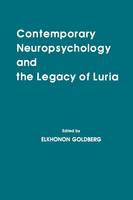
Best known as a founding father of neuropsychology, Luria is remembered for his clinical approach, which in many ways foreshadowed and served as the basis for the currently popular "process approach" to neuropsychological diagnosis. Although he never completed the job of designing a general theory of brain- behavioral relations, he nonetheless contributed mightily to the ongoing effort to develop one, and to the emergence of neuropsychology as a mature science. Written by professionals who either knew Alexandr Romanovich Luria personally or experienced his scientific influence, the topics examined in this volume reflect the expanse of his interests and contributions.
Contents:
Contents: E. Goldberg, Introduction: Tribute to Alexandr Romanovich Luria (1902-1977). M. Cole, Alexandr Romanovich Luria: Cultural Psychologist. D.T. Stuss, D.F. Benson, The Frontal Lobes and Language. A.F. Mirsky, H.E. Rosvold, The Case of Carolyn Wilson -- A 38-Year Follow-up of a Schizophrenic Patient with Two Prefrontal Lobotomies. K.H. Pribram, The Frontal Cortex -- A Luria/Pribram Rapprochement. N. Butters, D.P. Salmon, W.C. Heindel, Processes Underlying the Memory Impairments of Demented Patients. P.D. MacLean, A Reinterpretation of Memorative Functions of the Limbic System. E. Bisiach, Hemispheric Interaction and Decisional Dominance. A. Benton, The Fate of Some Neuropsychological Concepts: An Historical Inquiry. O. Sacks, Luria and "Romantic Science." J.W. Brown, Preliminaries for a Theory of Mind. H.G. Vaughan, Jr., Chronotopic Localization of Cerebral Processes: The Temporal Dimension of Brain Organization. E. Goldberg, Higher Cortical Functions in Humans: The Gradiental Approach.
PRODUCT DETAILS
Publisher: Taylor & Francis (Psychology Press Ltd)
Publication date: April, 2015
Pages: None
Weight: 560g
Availability: Available
Subcategories: Neurology, Psychotherapy